Orbit Podcast
Orbit 55
The corporate immune system: Google Cloud's Daniël Rood on building Europe's first AI team
Daniël Rood, director of AI go-to-market at Google Cloud, offers a masterclass in navigating transformation from inside a tech giant. Building Google's first European AI team when gen AI was still "a PhD science project," Rood reveals the hidden resistance mechanisms that plague even innovative organizations. His concept of the "corporate immune system"—the culture that protects success for all the right reasons but resists dramatic shifts—explains why customer success stories, not internal advocacy, are what actually move leadership. His hiring philosophy centered on "intellectual humility" and "teams of translators" who bridge technology and business offers a blueprint for staffing AI initiatives moving too fast for anyone to be an expert.
The conversation reveals Google's quiet dominance: AI Mode has already reached 1.5 billion monthly active users, nearly double OpenAI's reach. But Rood's most provocative insight addresses vertical SaaS: he predicts the shift to "expertise as a service," where repetitive professional work gets commoditized and deep human judgment becomes "an API on top of the platform." His framework for the new reality is stark—culture trumps strategy, three-year horizons are irrelevant, the world is "tokenizing," and sales cycles collapse through proof-based processes. By 2030, he argues, AI will have moved so deeply into the background that having a Chief AI Officer will seem as obsolete as having a Chief Mobile Officer today.
Listen on:
Inside the episode
The ‘corporate immune system’, the culture that protects a company’s success for all the right reasons, is also the force that resists dramatic shifts. Customer success stories, not internal advocacy, are what actually move leadership to embrace AI transformation.
Google’s AI Mode has already reached 1.5 billion monthly active users, nearly double OpenAI’s reach. This is a scale advantage that is often overlooked in the narrative dominated by ChatGPT and startup challengers.
Vertical SaaS is heading toward ‘expertise as a service’, where repetitive professional work gets commoditised and deep human judgement becomes an API on top of the platform.
By 2030, having a Chief AI Officer will seem as obsolete as having a Chief Mobile Officer today.
Hiring for AI teams should prioritise ‘intellectual humility’ and translators who bridge technology and business. Three-year strategic horizons are irrelevant when the world is tokenising: sales cycles collapse through proof-based processes, and culture trumps strategy every time.
Episode transcript
Chris Ross
Welcome to Orbit, the Hg podcast series where we talk to successful leaders of technology businesses and hear how they've built some of the most successful software companies across the world. I'm Chris Ross, head of growth for Hg's value creation team, and I'm delighted today to be joined by Daniel Road, director of ai go to market at Google Cloud.
Daniel built Google's first AI team in Europe and now leads enterprise AI adoption at scale. His experience puts him at the sharp end of both the technical capabilities and business transformation required to make AI work in practice something Hg are only too interested in. As enterprises navigate the shift from AI experimentation to real implementation, Daniel is on the ground helping companies deploy, and he's an invaluable voice in understanding where AI is heading with that. Daniel, thank you for being here.
Daniel Rood
Thank you for having me, Chris.
Chris Ross
So let's kick off. I've got a number of questions that I'm dying to ask you. You know, you've had an impressive career spanning Dow Jones, SAP, and now Google. What's the thread that connects these experiences and how did each of them prepare you for leading this AI adoption at Google Cloud?
Daniel Rood
It is interesting because if you look at it from the surface, I don't think Dow Jones or SAP or or Google have much in common. Definitely not from an AI perspective. However, if I now think back it was probably a bit of a journey of information and from information to intelligence, if you think about Dow Jones very much about finding signal in the noise, but also about the, the philosophy of data, that was absolutely critical for them. And I think that was a really great insight that I, that I got there.
But then moving into SAP, you get to work with enterprises where a lot of the processes are mission critical and going at speed has a different meaning in that context, and you can't just go and break things obviously. So it was really fascinating to see there how information was of such value and so deeply embedded in business processes and how customers think about that.
And then comes Google, where of course, through the lens of ai, all of a sudden these two worlds come together. You have the philosophy of data and the importance of data and, and finding the signal in the noise linked to mission critical business use cases. And so we need to bring this exciting innovation at a scale but also scalable, reliable, and secure for organizations to use with their most sensitive data. So that has been quite a, an interesting journey in a way.
Chris Ross
Yeah. I think that that felt like a really good thread actually, between those companies. So you get to Google and you, you are building the first AI team in Europe. Take us back to the moment, you know, what was the pitch internally? How did you justify how you were gonna build this team and was there resistance or skepticism in, in what you were trying to build?
Daniel Rood
There definitely was. Okay. And this was a time, it's difficult to imagine now where everyone in the boardroom is talking about ai. At the time it was still a bit of a PhD science project. And so when we started to see the first startups predominantly in this space, I thought that this was gonna be a big opportunity for us because if you, especially if you look at Europe, there was one big challenge in the enterprise, which was that they are data rich, but inside poor.
And so, it was really difficult to, to get the insights from their data and this technology in its new form because AI has been around for much longer, obviously. But this gen AI capabilities specifically made it easier for any business user to start querying the data in a, in a very human-like way. So it's almost a new UX on top of data. So when, when we started to see the, the first signals, I raised this as a big opportunity, and indeed that was faced with some scepticism. The, the early feedback probably was we have teams in the US that can come in and, and help us on the ground. There were people saying this technology is definitely not good enough yet for us to use.
Again, if you think back about those early models, especially for Google, as we were iterating our own models, there were sometimes the headlines of Gemini not performing as it should have done, and sometimes sharing some recommendations and advice that it probably shouldn't give. And so this was all very sensitive in the company. Not everyone saw the scaled opportunity. What we tried to do was, first I just pivoted a couple of headcount on the team to focus on this motion, and then when we started to create success, we started to breed success. And so of course people started to notice and, some of these start-ups then very quickly get to their own success, getting to the headlines. And of course, I think very quickly soon after people realized that this was probably the next big thing for us. And so we started to see the investment that we had inin hindsight.
Chris Ross
Yes, It's interesting. So you, you've pivoted a few people internally, but then as you started hiring, you know, the first team members bring them in, you know, and how that's evolved, kind of AI's gone from experimenting, it's now mission critical, you know, what did you look for in the, in those first hires that you were bringing in from, from outside?
Daniel Rood
Again, it's, it's quite difficult putting myself back into the mindset we had done. But what it was really about was intellectual humility. I think you needed super smart people who also accepted that they didn't know anything, which sounds a bit odd, but if you think about the speed with which this was going, especially at the time, it was just impossible for anyone to be completely up to date to the latest development, whether it was purely technical, but also it's application.
And so you needed people who were hyper curious, very technical, and could start to apply, that to the business you needed translators. That is really what I was looking for, people who could take technology to the business. And as we started to mature, you started to specialize. So then when the enterprise discovered this and we started to see much more scaled success, you are then looking for a further maturity of the team in terms of specialism in certain industries, for instance. But I would say building a team of translators was probably the, the key capability I was looking for at the time.
Chris Ross
And shifting gears a little bit, you know, Google invented the transformer architecture that powers modern ai, and yet you still had to advocate internally for AI adoption, right? How, how do you drive the urgency for transformation in a company that's kind of already successful and technically sophisticated?
Daniel Rood
Yeah. If, if you have a company with the revenue base that Google has with the brand that Google has, and lots of people think about the risk, then there is also the, the innovator's dilemma, which is we have our own products and solutions, and they were of course already very successful at the time. And so introducing something new also means that we are potentially going to introduce risk to the business. So I think that's a, that's a natural human component that was even true in Google.
They're is also this corporate immune system that kicks in, which is I think a culture which exists in every company that has the function of protecting its success for all the right reasons. But if you need to make a dramatic shift as everyone had to make, and, and us for sure, you start to see that corporate immune system activated, which meant that we had to convince the leadership team in different ways.
And the the best way to do that is by bringing customer success. So we started to do round tables with chief executives who we were working with, who were sharing with our leadership, how they were applying this technology in ways that they couldn't do before. You then start to see traction with the right people in the organization that could give us the, the room and the space to develop the, the business and also protect us a little bit from the usual success criteria that we would probably have in place for a business.
I wouldn't say that we didn't need to show revenue but those questions were asked later. It was understood that we had to build this capability first, get to successful customer use cases before we could start to ask the, the usual KPIs of the business.
Chris Ross
That's really interesting. And then, you know, if you think about the fact you're surrounded by well-funded startups like perplexity and others who can move really fast, they can take the risks, they probably don't have that immune system that, that you just talked about. You know, how does Google compete when you've got this legacy business and the legacy business models that you've gotta protect and the scale to protect as well? How, how does that work?
Daniel Rood
I have a lot of respect for perplexity and many of their peers. Phenomenal, well-funded, very talented people really interesting propositions. But I do think we're, we're playing a different game. I don't think we're doing the same thing necessarily. And if you think about the scale of Google with billions of daily active users, there's true societal impacts that we have to consider as something that people often forget is if you would consider how many queries we get a day of people searching for certain medicine, for instance, or the impact of medicine. These are really important engagements that we have with our users.
That also means that we have to take a, a slightly different approach. I think we're in a different game. What is really interesting is in good Google fashion, I think we sometimes keep the best things a little secret is if you consider that OpenAI currently has about 800 million monthly active users, which is absolutely phenomenal. We launched AI mode, which is now effectively our new search capability in Google search. AI mode is over one and a half billion monthly active users. So effectively we have the biggest AI application in the world. Our approach will be different Yeah. Than some of the, the niche players.
Chris Ross
No, that makes perfect sense. And then, you know, you, you take that lens and move to thinking about how AI capabilities are evolving every few months, right? You know, how do you lead teams set a strategy when the landscape shifting all the time and at such a pace, you know, what's your framework for making decisions in that kind of environment?
Daniel Rood
Yeah, so the old a says culture, each strategy for breakfast, and it's, it's very true that the sort of three year, five year horizons, are absolutely not relevant anymore. I think that's, in our world a very difficult exercise. And so culture becomes absolutely critical. And, and in that sense, strategy has probably become more of a vector. It's more of the direction this is going and the velocity with which you're going. And so from a cultural perspective, I am probably looking much more at curiosity in the teams, helping them with focus, because with every new development, there's a lot of exciting things happening, making sure that they're focused on the real high value use cases, both for the customer as well as our business, absolutely critical.
But also making sure that they make the right decisions and go at speed. So giving them the opportunity to go fast and inform decisions much quicker, which ultimately then leads to a strategy. But at the moment, with the speed at which we're going, you could say for us, the world is tokenizing. So we think of the world in terms of tokens, and so we translate a business use case in tokens and that sets our strategy and that informs us of where the big price is for, for Google. But it's going to be very difficult to tell you what this world will look like in a couple of years from now.
Chris Ross
Well, I'm gonna challenge that thought now with, with one final question. Great. And so if we were sitting down and doing this exact same podcast in 2030, what's gonna, right. Imagine, look out to 2030 if you can. What's, what will have fundamentally changed about how businesses operate and what role will Google Cloud have played in in that transformation?
Daniel Rood
2030? I, what I hope we will be is that we will be the AI backbone for the enterprise. That is what I hope we will be, and that we will have matured our capabilities to a point where it has become very easy for any organization, large or small, to, to consume the ai use cases that they're pursuing.
I also think by then that AI will move to the background. So today we talk about an AI strategy. It's a bit similar to how we thought about a mobile strategy or even an innovation strategy. You cannot imagine that a company today would have a chief mobile officer, right? Because everyone has an app, obviously. I think the same is already true for innovation as well. If, if an organization has a chief innovation officer, that is always an interesting one because innovation should be culturally inherent to the organization that there's not one person or a team that should care about that or even be responsible. It's everyone's responsibility. So everyone is going to be in ai, and therefore I think it will almost move to the background and just be fully embedded in, in what we do day to day.
Chris Ross
Yeah. Really interesting. Interesting thoughts there. So, last question from me. What are you personally most excited about in the AI future that isn't getting attention in the hype cycle and being talked about broadly?
Daniel Rood
Yeah. One thing that I'm very excited about also at a personal level is the impact it's going to have on healthcare and, and medicine. I think there's a lot of hype around AI in many areas of, I guess our, our lives and, and society. But solving for some of our most critical healthcare challenges, I think is probably gonna be one of the, the best promises of ai. And we're seeing incredible advancement in, in that area, which is phenomenal.
Just in the last two weeks we have launched different models that have shown new pathways to solving for cancer, for instance. We've launched models that have helped dramatically with mapping proteins. And mapping proteins is one of the critical steps that we need to take in order to solve cancer. Just so to bring it to life, to, to get a sense of what the impact really is of AI there. So, folding one protein used to take, one PhD five years and we launched Alpha Fold, which is an AI model specialized in protein mapping.
It helped map 200 million proteins in a year. So now we have a public database that is to doctors worldwide that they can now use and apply to their research. And this is going to dramatically accelerate well in this case, hopefully getting to solving cancer at some point.
And the other one that I think is going to be absolutely incredible is embodied ai, meaning bringing AI into our physical world. And we're starting to see this with drones. So we've done a number of really interesting pilots with the NHS in, in the UK and London, where we are delivering medicine to certain points which is of course, much faster through autonomous drones. We have Waymo in Alphabet, our autonomous driving vehicles, and this is now also coming to Europe. We're also doing this already in nine cities in the us. We've done 19 million rides already. I've been in one. Fantastic. Yeah. Incredible. So, so that is coming into our lives. Yeah.
And then we're gonna get into proper robotics factories where we'll have robots that can understand and perceive the world the way that we do. I think that is going to probably drive an, an economic impulse that we've never seen before. That's my expectation, so, yeah.
Chris Ross
Wow. Yeah. Really, really interesting view. And the, the protein folding sounds incredible. Yeah. Yeah, It's Pretty impressive. It's amazing. Listen, Daniel, it's been great chatting with you. Really insightful.
Daniel Rood
Thank you for having me.
Chris Ross: And so thank you for your time and, cheers. Yeah. Look forward to catching up again with you in 2030 to see what, see what really happened, but, oh
Daniel Rood
We'll see. We'll play the recording first.
Chris Ross
Exactly. But in the meantime, it's been a real pleasure. Thank you for your time today.
Daniel Rood
Thank You, Chris.
Orbit episodes
Latest
Orbit Podcast
The rogue agent problem: A conversation with Gil Elbaz at the Hg Digital Summit
Episode details
Orbit Podcast
Patrick Debois on why context is the new code: a conversation from the Hg Digital Summit
Episode details
Orbit Podcast
Marjorie Janiewicz of Mistral AI: flipping the adoption curve - why SaaS with data can win in an AI world
Episode details
Orbit Podcast
The race for alpha: Varun Anand of Clay on inventing a new role and why GTM needs a new AI strategy
Episode details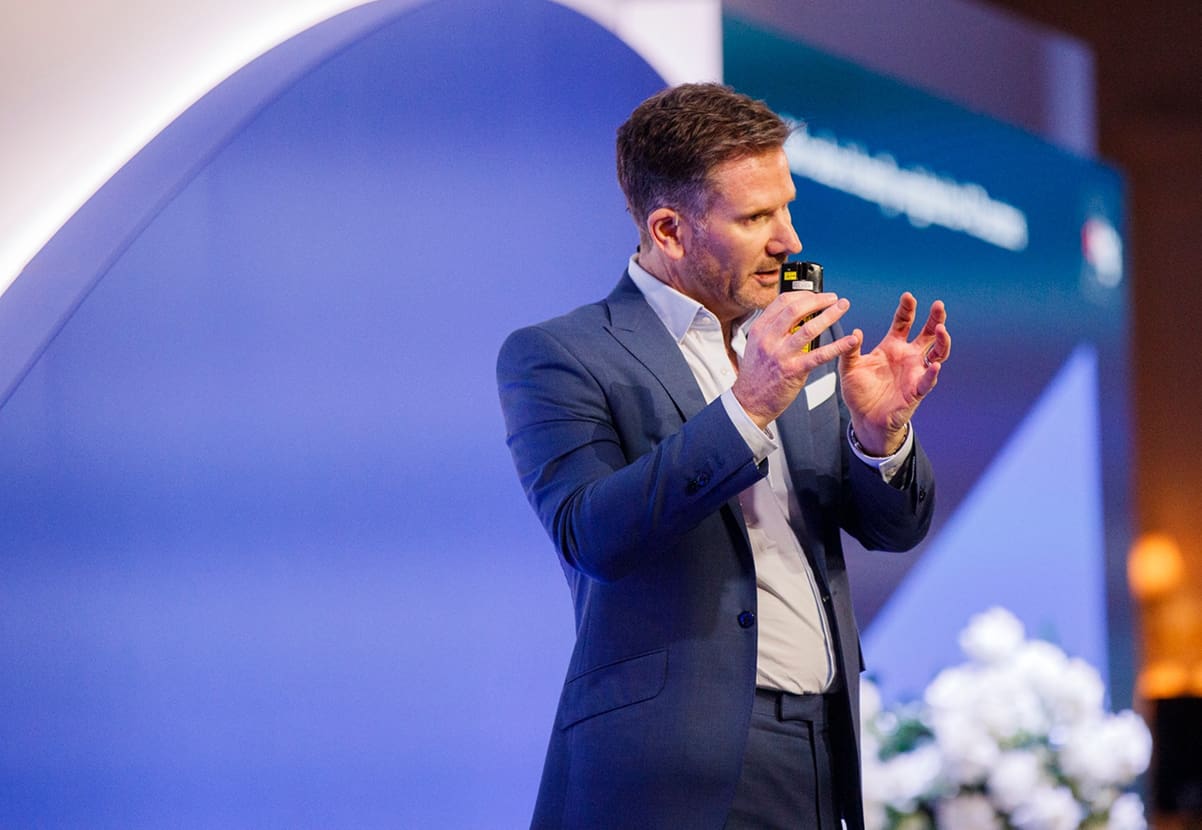
Orbit Podcast
Everything, everywhere, but not all at once: Matthew Brockman on what's really happening in software right now
Episode details
Orbit Podcast
A certain level of chaos is healthy: Franz Faerber on fighting bureaucracy and the importance of deep domain knowledge in AI
Episode details
Orbit Podcast
Skin in the game: Professor Neil Lawrence on vulnerability, accountability and why the next generation will thrive.
Episode details
Orbit Podcast
The 3 speed problem: Oji Udezue on CPO leadership in the age of unlimited engineering
Episode details
Orbit Podcast
Fevered determination: Building Zalos from zero to enterprise in 5 weeks
Episode details
Orbit Podcast
Trust, velocity, and building the Answer Engine: Dmitry Shevelenko of Perplexity speaks to Farouk Hussein
Episode details
Orbit Podcast
The long road to the last mile: Nic Humphries and Matthew Brockman reflect on 25 years of Hg
Episode details
Orbit Podcast
AI, Control Points, and the Next Wave of Vertical SaaS with Tidemark Capital founder, Dave Yuan
Episode details
Orbit Podcast
A glimpse of the next generation: Zoe Zhao and Annalise Dragic of Azlin Software
Episode details

Orbit Podcast
The business case for AI: Brent Hayward of Salesforce, David Carmona of Microsoft & Nagraj Kashyap of Touring Capital
Episode details
Orbit Podcast
Mastering the billion-dollar software playbook: Joe Lonsdale of 8VC & Eric Poirier of Addepar
Episode details
Orbit Podcast